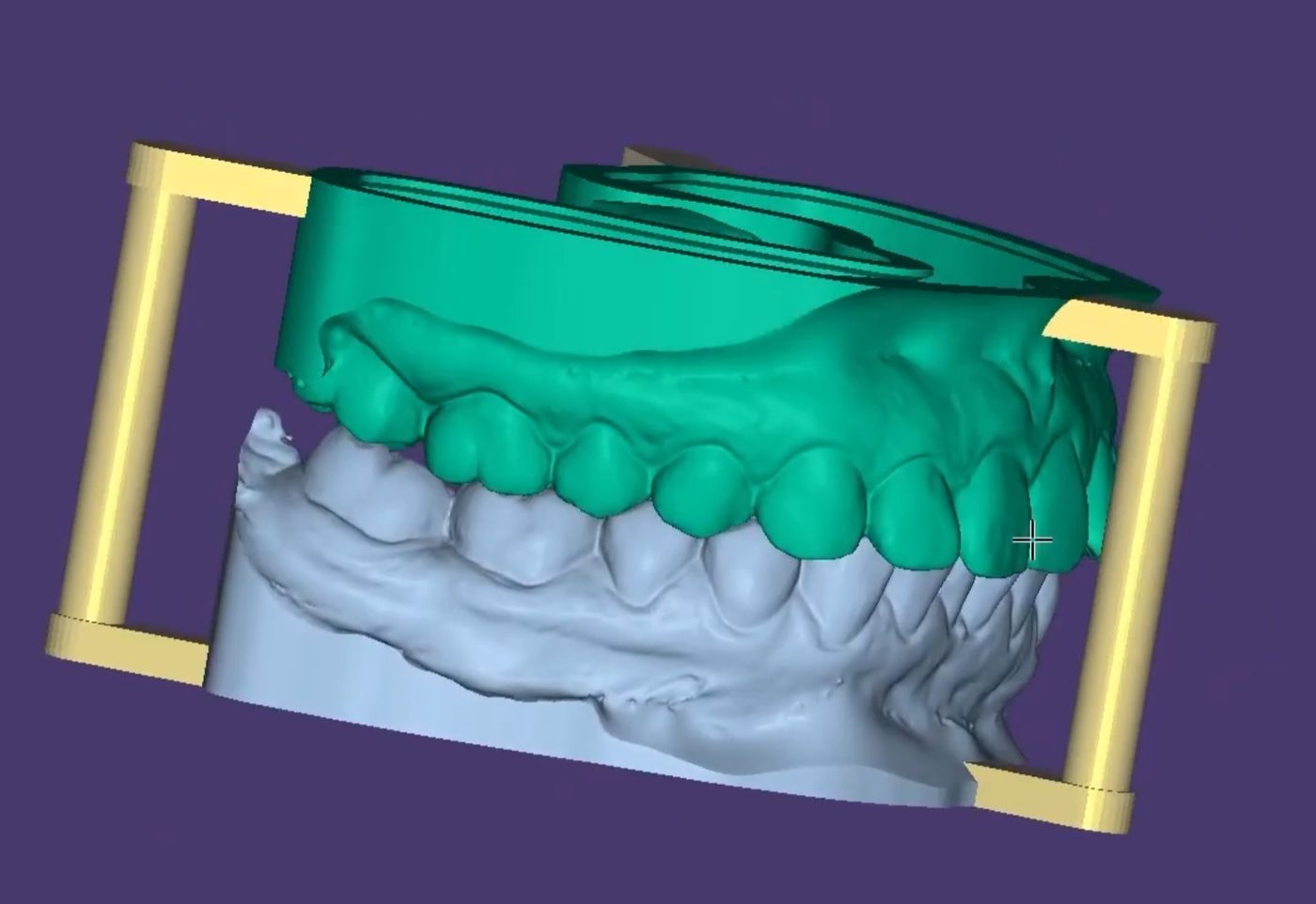
Why we do not start a case without a bite
Every restoration that touches the opposing teeth is designed against a relationship between the two arches. The bite registration is what tells the software where the antagonist actually sits. Without it, the upper and lower scans float independently and any contact, clearance or occlusal anatomy the designer creates is a guess.
That is why our case form states that the bite registration is essential: a crown designed without it may be high, a splint may not seat evenly in occlusion and a denture setup has no reference for vertical dimension. Sending it with the first upload is the simplest way to keep the 24-hour turnaround on routine cases.
What counts as a bite registration in a digital workflow
For dentate cases scanned intraorally, the bite is usually captured as one or more buccal bite scans with the patient closed in the position chosen by the clinician. The scanner software then aligns the upper and lower arches. Export the arches already aligned, or include the bite scan so the alignment can be repeated.
For lab workflows starting from impressions or stone models, a scanned bite record or articulated models scanned together provide the same information. For edentulous cases, the relationship normally comes from record bases and wax rims or an existing denture, as prescribed by the clinician. The jaw relationship itself is a clinical decision; the designer works from the record supplied.
Common bite problems that delay a case
- No bite at all — only the working arch and antagonist exported separately
- Bite captured on one side only on a case that involves the other side
- Bite material or retraction cord left between the teeth during the scan
- Arches exported from different scan sessions with no common bite
- Patient closed in a different position from the one prescribed
- Antagonist scan trimmed so far that the contact areas are missing
Quick check before you upload
Open the exported files together in any STL viewer. The upper and lower arches should appear closed on each other, with the teeth touching where you expect them to touch. If the arches appear apart or crossed through each other, the alignment is missing or wrong and should be fixed before sending.
Name each file by its role — for example working arch, antagonist and bite — so nothing is mistaken for something else. If a bite is genuinely not available, tell us in the message field before upload so we can agree what can be designed safely.
Which cases need it
Crowns, bridges, inlays, veneers, implant crowns, night guards, full and partial dentures and full-arch restorations all depend on the relationship between the arches. Some items, such as a model or a custom tray, may not need it — but if you are unsure, include it. A bite that turns out not to be needed costs nothing; a missing bite costs a day.
Frequently asked questions
- Can you design a crown without a bite registration?
- Not reliably. Without the bite we cannot set contacts or clearance with the opposing teeth, so we ask for it before starting.
- Is a buccal bite scan from an intraoral scanner enough?
- For most dentate cases, yes, as long as it is captured in the position prescribed by the clinician and covers the area being restored.
- What do you need for a denture bite?
- A jaw relation record chosen by the clinician, usually from record bases and wax rims or an existing denture, scanned together with the arches.