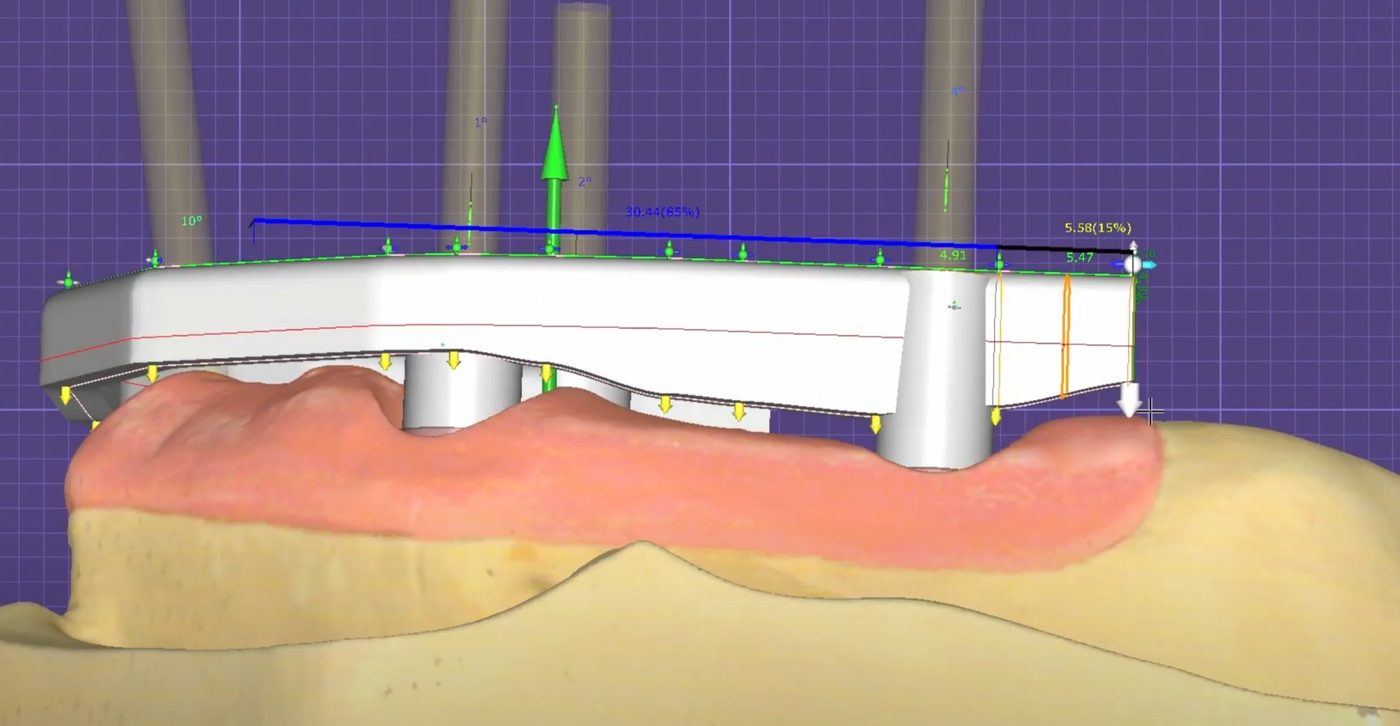
What a snap-on denture is
A snap-on denture, also called an implant overdenture, is a removable denture that clips onto attachments on two or more implants. The patient can take it out for cleaning, but it is held much more firmly than a conventional denture. It is different from a fixed hybrid denture, which is screwed to the implants and is removed only by the clinician.
The number of implants, the attachment system and whether a bar is used are decided by the clinician. The denture design has to be built around those choices from the start.
The main attachment options
- Locator-type attachments — individual attachments on each implant, with housings and replaceable inserts in the denture base
- Ball attachments — a ball on each implant and a matching housing in the denture
- Bar with clips or attachments — the implants are joined by a milled bar, and the denture clips onto the bar
- Milled bar with a secondary structure — a precise primary bar and a matching part inside the denture for more retention
How the attachments change the denture design
The tooth setup and the base are designed as for any complete denture: tooth position, vertical dimension, midline and occlusion follow the records the clinician provides. What changes is the space inside the base. Each housing needs room in the base, with enough material around it so the denture does not crack over the attachment.
The path of insertion is checked against the implant angles. Attachment systems can only correct a limited amount of angle between implants, and that limit is set by the manufacturer. If the implants are far from parallel, we tell you before designing so the clinician can choose angled attachments or a bar.
Before design we measure the vertical space between the implants and the planned teeth. A bar needs more space than individual attachments, and the teeth, the base, the housings and any bar all have to fit within it. Where the space is tight, a reinforcement or a different attachment may be needed, and that decision goes back to the clinician.
What to send
Send scans of both arches with the correct scan bodies or attachments in place, the implant brand and platform, and the attachment system and height you will use. Add the jaw relation record, and a scan of the patient's existing denture if they are happy with it, because it is often the best reference for tooth position. The bite registration guide explains what to capture.
On our price list a full denture design is $50 per arch with a 24-hour turnaround. If the overdenture sits on a bar, the bar design is $100 per arch. Revisions are included until you approve the design.
Frequently asked questions
- Do you design snap-on dentures?
- Yes. Tell us the implant system, the attachment type and height, and send scans with the scan bodies or attachments in place.
- What is the difference between a snap-on denture and a hybrid denture?
- A snap-on denture is removable by the patient and clips onto attachments. A hybrid denture is screwed to the implants and removed only by the clinician.
- How much does a snap-on denture design cost?
- Full denture design is $50 per arch on our price list. If the denture sits on a bar, the bar is $100 per arch.