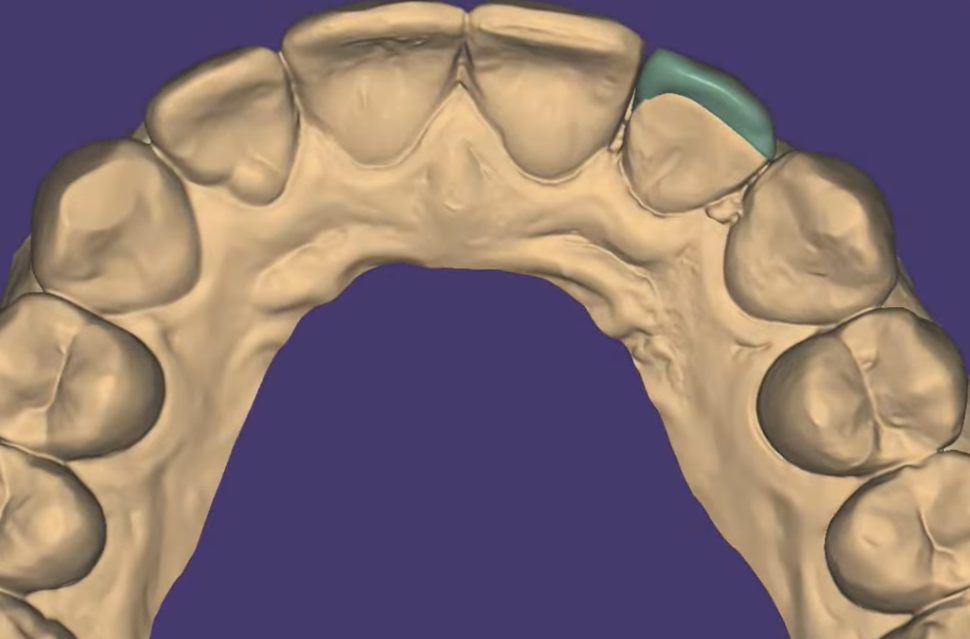
What a cantilever bridge is
In a conventional bridge the missing tooth is held by an abutment on each side. In a cantilever bridge the pontic is attached to an abutment on one side only, and the other side is free. The abutment can be a natural tooth, more than one splinted tooth or an implant.
Because all the load on the pontic goes through one connector, a cantilever bridge is designed differently from a bridge with support at both ends. Whether a cantilever is suitable for the patient is a clinical decision made by the dentist; we design the bridge that was prescribed.
Common cantilever designs
- Conventional cantilever — a full crown on the abutment with the pontic attached on one side
- Resin-bonded cantilever — a single wing bonded to one abutment tooth, often used for a missing lateral incisor (see our Maryland bridge guide)
- Implant-supported cantilever — a pontic extended from one or more implant crowns where an implant cannot be placed
- Distal cantilever on a full-arch bridge — the last teeth extended beyond the most distal implants
The design decisions that matter
The connector is the critical point. It has to meet the minimum connector size the material manufacturer gives for a cantilever, which is usually larger than for a bridge supported at both ends. We check the connector height and width against the available space and tell you before export if the case does not allow it.
The pontic is shaped so it is easy to clean and does not load the connector more than needed. Its size is kept in proportion to the space, and its contact with the ridge follows the pontic type the clinician asks for, such as ovate, modified ridge lap or sanitary.
Occlusion is set so the pontic does not carry heavy contacts. On most cantilevers the pontic has light or no contact in the bite and stays out of contact in side and forward movements. If the clinician wants a different scheme, tell us and we design to it.
What to send
Send the scan of the prepared abutment, the full arch, the antagonist and the bite registration. Tell us the tooth numbers, which tooth is the abutment and which is the pontic, the material and whether the bridge will be milled or printed. For implant cantilevers, include the scan body, implant brand and platform.
We return a milling- or printing-ready STL with screenshots for approval. Bridges are charged per unit, our prices are on the pricing page, and revisions are included until you approve the design.
Frequently asked questions
- Do you design cantilever bridges?
- Yes, on natural teeth and on implants. Tell us which tooth is the abutment, which is the pontic, and the material you will use.
- How big should the connector be on a cantilever bridge?
- At least the minimum the material manufacturer gives for a cantilever. We check it on every case and tell you if the space does not allow it.
- Does the pontic touch the opposite teeth?
- Usually only lightly or not at all, and it stays out of contact in side movements. We follow the occlusion scheme the clinician prescribes.